
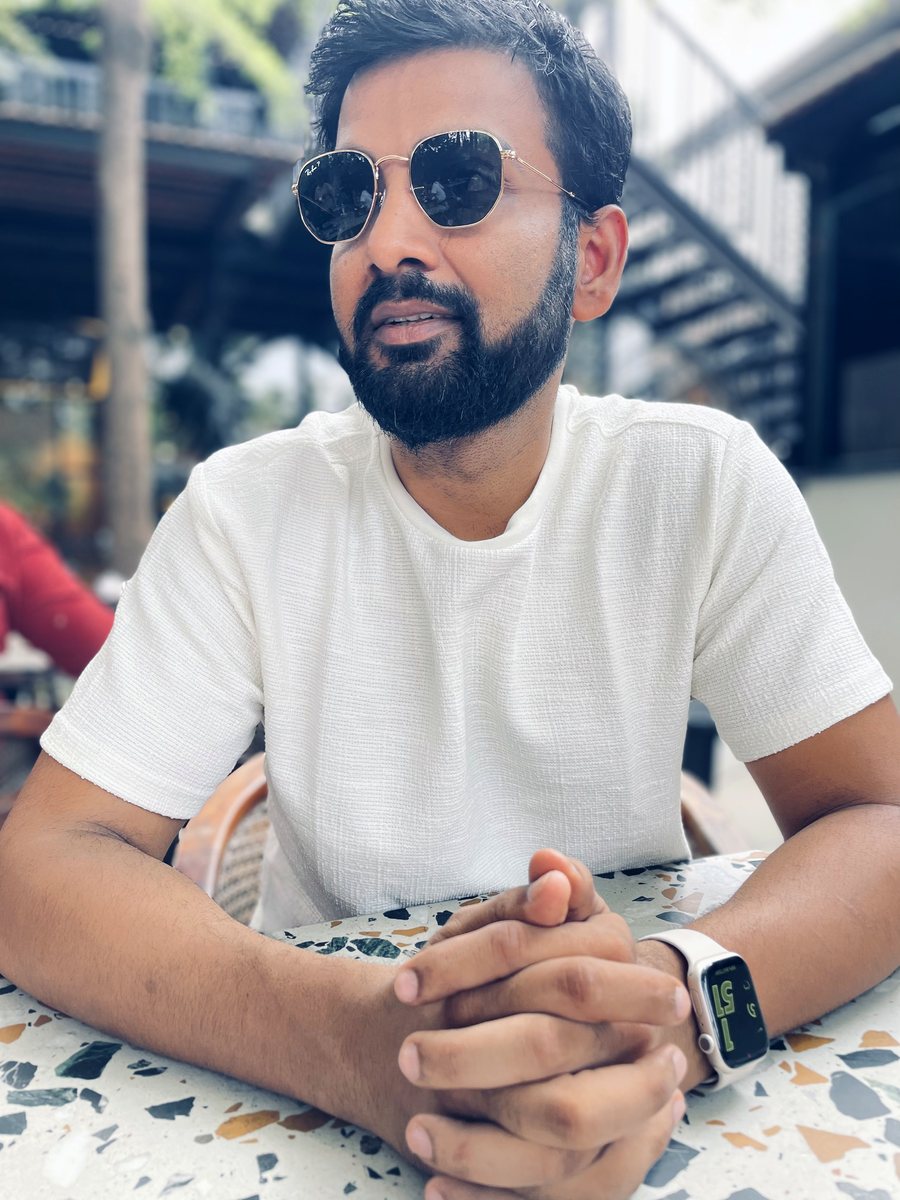
AI & growth · Founder, NuroSparx

Sandeep Kumar Jha

AI growth leader and founder of NuroSparx. I put AI into the marketing and operations of US companies doing $5M to $100M a year, and I write about what works, with numbers.

Sandeep Kumar Jha
Sandeep Kumar Jha
India ↗ working globally
$26M → $48M
revenue at the operating company
3x
online business in the same period
5x
AI-search traffic converts vs Google organic
5 brands
on 12 research units a month
01  /  Who I am

Founder of NuroSparx, VP of AI and Growth, and ex-Google.

I'm Sandeep Kumar Jha, an AI and growth leader based in India who works with US mid-market companies. I founded NuroSparx, a growth company that builds AI systems for marketing: search and answer engine optimization, AI automation with n8n, Claude and GPT, content engines, and lead generation. I'm also VP of AI and Growth at a growing automotive service company in Florida and Arizona, where the online business grew 3x and revenue went from $26M to $48M.

Before this I spent ten years in growth, product marketing and category roles at Google, Flipkart, Bharti Airtel, Marico and Kraft Heinz, after an MBA from XLRI Jamshedpur and a B.Tech from NIT Jamshedpur. Google showed me how the ad machine works from the inside. Flipkart taught me scale. Sales at Kraft Heinz taught me how a missed target feels on a Monday.


Thrice a month, I send my takes and learnings on growing businesses with AI. That's it.

02  /  What I'm known for
  • 01AI automation for marketing teams. n8n and custom workflows with Claude and GPT that cut reporting, research and content production from days to hours. I run five brands on 12 research units a month with a small team.
  • 02Answer engine optimization (AEO) and generative engine optimization (GEO): I get brands recommended by ChatGPT, Perplexity, Gemini and Google AI Overviews, then measure whether that traffic converts. It does, at about five times Google's rate.
  • 03AI adoption inside companies. I build the first five automations with the team you already have, keep rollouts data-safe, and set up a way to check AI's work before it ships.
  • 04Model testing with receipts. I run every major model release on real work the day it lands and publish what changed, with cost and speed numbers.
  • 05Growth leadership. 3x online revenue and $26M to $48M at an operating company, category P&Ls at Flipkart, go-to-market at Airtel.

The road so far

today → 2009
Still on the road.
  1. 2025–WorkSTOP 10

    NuroSparx

    AI growth company for US mid-market brands.

    Founder

    Put AI into the marketing and operations of US companies doing $5M to $100M a year.

    What I did there
    • Founded in June 2025. India-based team, US mid-market brands.
    • Puts AI into paid growth, automation, AI search visibility and reporting.
    • Five brands and 12 research units a month at last count.
    ● Building here, now
  2. 2023–WorkSTOP 09

    A growing automotive service company

    Florida and Arizona, United States.

    VP, AI and Growth

    Tripled the online business and took the company from $26M to $48M in revenue. Still here.

    What I did there
    • Own growth, technology and AI for a US automotive service company with operations in Florida and Arizona.
    • Tripled the online business and helped take the company from $26M to $48M in revenue.
    • Built the AI systems behind marketing, lead handling and reporting.
  3. 2021–23WorkSTOP 08

    Google

    Ad products for Asia Pacific: Discovery, Display and Performance Max.

    Senior Product Specialist, APAC

    Ran product adoption and experiments on Google's AI-driven ad products. $20M+ in ad spend, $60M+ in advertiser revenue.

    What I did there
    • Drove $20M+ in ad spend on Display, Discovery and Performance Max across Thailand, Singapore and Indonesia, worth $60M+ in advertiser revenue.
    • Ran A/B tests on cookieless ads and Performance Max campaigns, and fed the results into the product roadmap.
    • Led APAC adoption of Display and Video Optiscore, a self-serve optimisation portal, and drove $23M in incremental revenue.
    • Led Discovery Ads growth: piloted in Malaysia, scaled to Thailand, Singapore and Indonesia, a $5M opportunity from lower churn.
    • Led the Display Ads vendorisation project with self-serve optimisation, saving about $2M a year.
    • Built growth plans and ran C-suite reviews with 18+ large customers including KFC, Carsome, P&G and Maxis.
  4. 2021WorkSTOP 07

    Bharti Airtel

    One of India's two biggest telecom companies.

    Senior Growth Product Manager, Prepaid Acquisition

    Built self-serve KYC for online prepaid sign-ups. Piloted in two cities, scaled to 34 cities and 600,000 leads a day.

    What I did there
    • Led the online prepaid acquisition product, the biggest online acquisition project of 2021 at Airtel.
    • Built the self-serve KYC flow with legal, tech, product and design teams, and ran weekly reviews with the CMO.
    • Piloted in Pune and Kolkata at 5,000 leads a day, then launched across 34 cities at 600,000 leads a day.
    • Ran performance marketing, go-to-market, brand and SEO teams for paid and organic sign-ups.
  5. 2020–21WorkSTOP 06

    Marico

    Consumer packaged goods. One of India's ten largest listed consumer goods companies.

    Head of E-commerce and Direct-to-Consumer, MD and CEO's office

    Built the direct-to-consumer channel for four brands in six months. Won the CXO award for it.

    What I did there
    • Set up and scaled direct-to-consumer for four skincare and food brands (Kaya Youth, PureSense, Saffola, Cocosoul) in six months. CXO award.
    • Reached 1,500 orders a day and about $360K (Rs 3 crore) in monthly revenue within six months, across 20+ stakeholders.
    • Designed the storefront UI, cart-to-conversion flow and A/B tests on ads, landing pages and calls to action. Click-through above 2.5%.
    • Built a team of 18: three in-house plus five partner teams across SEO, performance marketing, tech and UI, supply chain and customer service.
    • Led the marketplace business: strategy, ads and listings, and grew it 2.4x in one year by adding new online channels.
  6. 2017–20WorkSTOP 05

    Flipkart

    Walmart Global. India's largest e-commerce company.

    Category Manager to Category Head to Growth and Product Marketing

    Sports and fitness, then food and nutrition, then large appliances. Search, pricing, recommendations and fintech products. Walmart bought the company while I was there.

    What I did there
    • Sports and Fitness: led search, recommendation, pricing and merchandising for the category. Sales grew 107% year on year to about $72M (Rs 600 crore), third largest in the business unit.
    • Shipped contribution-margin pricing, pricing automation and price elasticity models: 11% better margin on the same units.
    • Food and Nutrition: built the category from zero to a $95M (Rs 800 crore) annual run rate in 12 months with a team of five.
    • Reworked the search product: 25% higher click-through on search terms and 16% better conversion from keyword mapping. Category traffic up 85%.
    • Large Appliances: launched Holiday EMI (20% higher adoption than standard EMI), Complete Protection and No Cost EMI on 60% of the high-ticket range.
    • Set up Flipkart Buyzones in 10,000+ stores across 80 cities in six months, about $1.2M (Rs 10 crore) of extra business a month.
    • Cut returns by 20 basis points with an automated cash-on-delivery block, image checks and installation fixes, from one year of data.
  7. 2016–17WorkSTOP 04

    Kraft Heinz

    Global food company. India business.

    Management Trainee, then Area Sales Manager

    Ran an $18M a year territory, grew it 23% and won best Area Sales Manager in the country.

    What I did there
    • Headed South Bengal, the third biggest territory by volume: about $18M (Rs 150 crore) a year, growing 23% year on year.
    • Hired a field team of 42 and a network of 28 distributors from scratch. Attrition: zero.
    • Grew secondary sales 1.52x in March 2017 over the year before. Won the Best Area Sales Manager award in the country.
    • Launched New Best Ever Complan, Kraft Cheese and the first regional ACV rollout, worth about $2.9M a year in new business.
  8. 2014–16EducationSTOP 03

    XLRI, Xavier School of Management, India

    Jamshedpur. One of India's oldest and top three MBA institutes.

    Business Management, Marketing and Strategy

    Two years to move from materials to markets.

    What I did there
    • Two-year full-time management programme, the Indian equivalent of an MBA.
    • Specialised in marketing and strategy.
  9. 2013–14WorkSTOP 02

    Exide Industries

    India's largest maker of lead-acid batteries.

    R&D Engineer, Recycled Lead project

    Ran recycled-lead trials in three factories. The changes saved about $1.2M a year.

    What I did there
    • Led the recycled lead project as technical lead at the central R&D centre in Kolkata.
    • Ran trials in three factories: Haldia, Hosur and Shamnagar. Saved about $1.2M (Rs 10 crore) a year.
    • An 8-week study of curing cycles cut trial time by 46 minutes per cycle.
  10. 2009–13EducationSTOP 01

    National Institute of Technology, India

    Jamshedpur. One of India's top engineering institutes.

    B.Tech (Hons), Materials Science and Engineering

    Four years of engineering. Later scored in the top 0.5% of 200,000 candidates in India's national MBA entrance exam.

    What I did there
    • Bachelor of Technology with honours in materials science and engineering.
    • Co-wrote a published paper on how casting parameters cause break-outs in steel production.
    • Scored CAT 99.5 percentile among 200,000 candidates and XAT 99.4 percentile among 100,000, the two national MBA entrance exams.
03  /  Work with me

If you run a $5M to $100M company and want AI in your growth engine, write to me. Journalists and podcast hosts who want someone who builds with AI every day, same address. I answer every mail myself, usually within a day.

sandeep@nurosparx.com

The Other Brain on LinkedIn: twice a month.

Latest posts

hover to pause
Sandeep Jha@kuronovaX · Sep 6

Voice mode is night and day between #codex and #claude. Not sure if this is a priority for Anthropic but it makes a huge difference in the amount of work done. I usually speak in gpt app and share the transcription to Claude , when the narration is large .

Sandeep Jha@kuronovaX · Sep 5

I’m on Claude max 20x plan and just use gpt occasionally. Only a plus plan there . Got access to Astra this morning. Tested by giving a task to fact check a long article of 8k words , and suggest edits. Limits expired . Added a reset . Expired again. Completed finally on a…

Sandeep Jha@kuronovaX · Sep 4

- You still plan, build, deploy and monitor. Coding agents removed the code-writing from that loop. You now spend your time deciding what to build, designing the architecture, writing the spec, and checking what the agent produced. - You decide how much effort each step gets. A…

Sandeep Jha@kuronovaX · Sep 3

now thats an update everyone's been wishing for . learn to use it optimally

Sandeep Kumar JhaFounder, NuroSparx3w ·

Was using Claude Code through Dispatch on my phone this morning when I caught myself doing the AI math again. Which model should I use for this job? Should I clear the context or type /compact? Should I send the browsing to a cheaper agent and save the expensive one for thinking? Should I keep outputs to /concise to save tokens? how do I ensure the limits stretch (across models ) before a reset hits. It reminded me how quickly these tricks become useless. Not long ago, I started some prompts with, “You are an expert dev with 20 years of experience.” I worried about chunk sizes. I wrote regex loops to fix broken JSON. I felt smart doing all of it. Most of those tricks are dead now. The tricks I use today, like choosing models, managing context, and saving tokens, are on the same path. So are the systems I build to preserve context and make sure each session picks up where the last one ended. I will keep using them because they help with the models we have today. But normal users should not have to think about any of this. One should not need to understand how the machine works to get good results from it. Tokenmaxxing should not be a skill for top 1% of AI users . The system should do that work for everyone. As capabilities evolve, saving tokens should become the model’s job, not another decision the user has to make.

…more
LikeCommentRepostSend
Sandeep Kumar JhaFounder, NuroSparx2mo ·

In 1962, Kenneth Arrow, who'd go on to win a Nobel, pointed out something odd about information. "You can't value it until you've seen it, and then it's free." Satya Nadella just flipped that on its head. He wrote an article called The Reverse Information Paradox, and it put words to something I've felt for a while using these tools. With AI, the buyer is the one giving away knowledge. You pay for the model with money, then you pay again by feeding it everything that makes your business work. And if you want better answers, you have to feed it more. Forget the documents you upload for a second. The models learn from your prompts, your tool calls, and most of all your corrections. Every time someone on your team fixes a wrong answer, a little hard-won judgment walks out the door. You'd never notice it happening. These labs trained on the whole public internet under fair use, then wrote terms that ban you from distilling their models, while keeping the right to learn from how you use theirs. The learning flows in exactly one direction. Ironic!! His fix is what he calls a trust boundary. Your evals, traces, feedback, and tuned models live in one place you control, and nothing leaves without consent. Own your evals. Train inside your own tenant. Never depend on a single model. Worth noting that Microsoft owns about 27% of OpenAI, and "decouple from any single model" happens to be great business for the company selling the layer underneath. Doesn't make him wrong though. In June a frontier model got pulled offline for 19 days over an export order, and companies built on it just sat there. You pay for AI twice. Most companies only track the first bill.

…more
LikeCommentRepostSend
Sandeep Kumar JhaFounder, NuroSparx5mo ·

Tried Claude Design. Three use cases: built a ppt, asked it to reimagine a website frontend, made a template using the Canva connector. Output looked great, as usual But .. I've done all three before using specific Claude skills. Same output. Similar quality. Those capabilities sat in the Anthropic skills repo for months. Anything you could run with code, you could already build. Claude Design feels like repackaging with new UI on top of what already existed. So why ship it? Because shipping itself is the strategy. Even sloppy first versions get attention, then improve at incredible pace. Look at the pattern. Anthropic ships micro announcements almost daily. Tiny features, small wraps around existing tech. Each one earns a news cycle. Each one feeds the algorithm. Each one tells builders "they're moving faster than everyone else, keep watching." The perception of speed compounds faster than actual speed.

…more
LikeCommentRepostSend